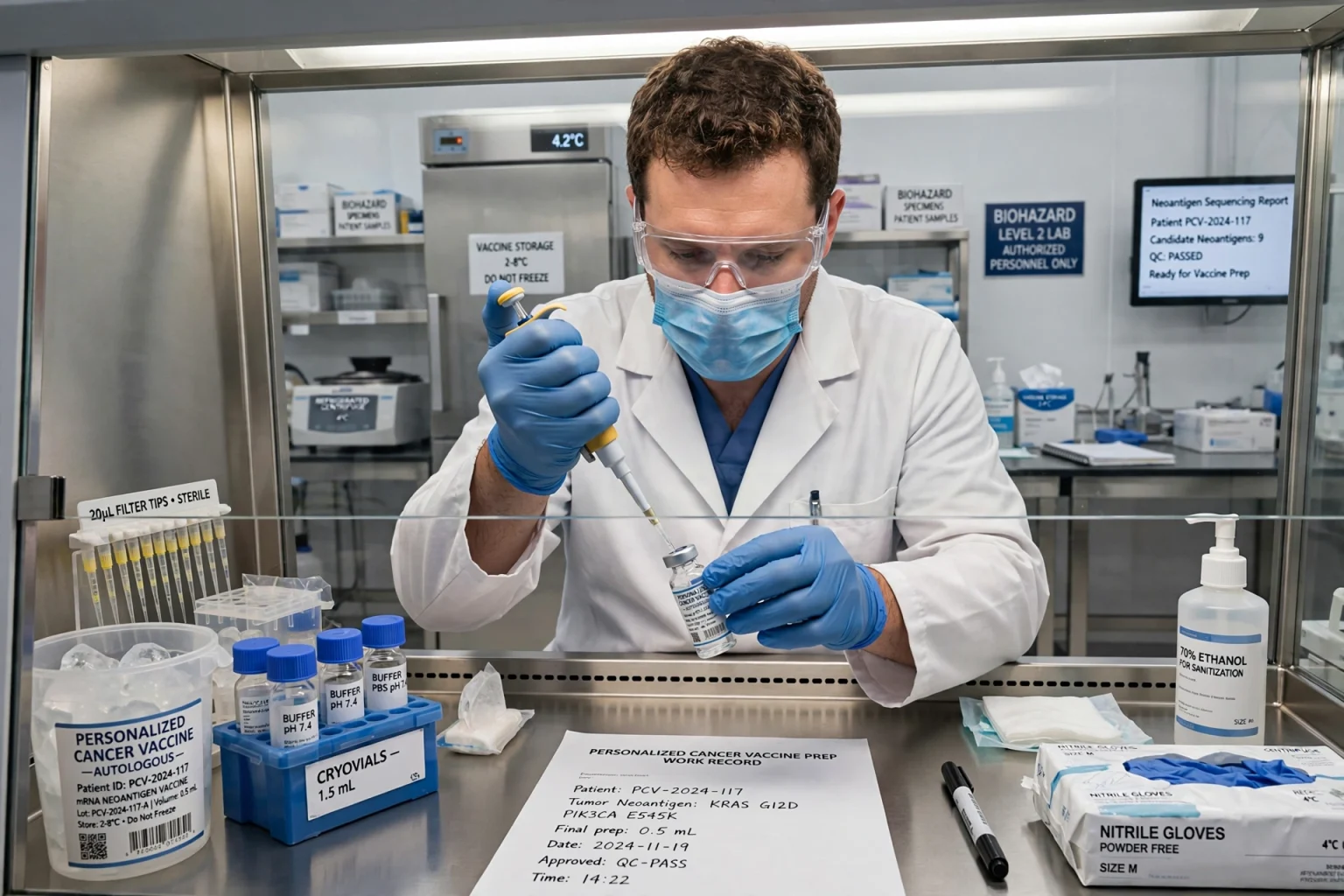

A personalised cancer vaccine made for each patient from the fingerprint of her own tumour has passed an early safety test in ovarian cancer, according to a phase 1 trial published in Nature Medicine. The vaccine, known as NeoVax, was given alongside the immunotherapy drug nivolumab to women whose cancers were sensitive to platinum chemotherapy. The researchers report that making and delivering the bespoke vaccines proved feasible, and that the combination’s safety profile was acceptable — a cautious but genuinely encouraging first step.
Phase 1 trials are not designed to prove that a treatment works. Their job is narrower and essential: can the therapy be made, given safely, and tolerated well enough to justify larger studies? On those questions, this trial offers a reassuring answer, while leaving the biggest question — whether the vaccine actually helps patients live longer — for future research to settle.
How a vaccine built from one tumour works
NeoVax begins with sequencing. Scientists read the DNA of a patient’s tumour and compare it with her healthy tissue, hunting for neoantigens: abnormal protein fragments produced by cancer mutations that the immune system might learn to recognise as foreign. A selection of those targets is then manufactured into a personalised vaccine, intended to train T cells to find and attack cells carrying the same markers.
Nivolumab plays a supporting role. It belongs to a class of checkpoint inhibitors that release a brake on immune cells, and the hope is that newly trained T cells will keep working rather than being switched off by the tumour. The science behind personalised immunotherapy is explained for general readers in journals such as Nature, whose pages carried this study.
Why ovarian cancer is such a hard test
Ovarian cancer is frequently diagnosed late, responds to chemotherapy at first, and then, in many cases, returns. Patients described as platinum-sensitive see their disease shrink with platinum-based drugs, yet relapse remains common, and each recurrence tends to be harder to treat than the last. That pattern is exactly why researchers are looking for maintenance-style strategies that might keep the immune system on guard after chemotherapy has done its work.
It is also why expectations must stay measured. A feasible, tolerable vaccine in a small early trial is a foundation, not a breakthrough headline. For another example of early evidence being reported carefully, see our coverage of a recent trial of glucose monitors in type 2 diabetes, where modest, well-measured gains mattered more than hype.
What the researchers can and cannot claim
The team can reasonably claim that personalised manufacturing worked in practice — no small achievement when every batch is unique and time matters for patients — and that combining the vaccine with nivolumab did not produce an unacceptable safety burden. Immune responses consistent with the vaccine’s design were also part of the early picture, suggesting the biological idea behaves as intended inside the body.
What the trial cannot claim is efficacy. Small phase 1 groups, usually without a comparison arm, cannot separate a vaccine’s effect from the effects of chemotherapy history, nivolumab itself, or simple chance. Anyone reading that this vaccine ‘fights cancer’ should translate that, for now, into ‘deserves proper testing’. That distinction protects patients from false hope while still recognising real progress.
What happens next for patients and researchers
The logical next step is a larger, controlled trial in which similar patients are randomly assigned to receive the combination or standard care, so outcomes can be compared fairly. Such studies take years, and many promising phase 1 approaches do not survive them — a normal, if frustrating, feature of cancer research. Patients interested in trials should discuss eligibility with their oncology team rather than seeking treatment outside a study.
For now, the fairest summary is simple: scientists have shown that a vaccine tailored to one woman’s ovarian cancer can be built and given with an established immunotherapy drug, safely enough to continue. In a field where personalisation has long been promised, demonstrating that the logistics, safety and immunology line up is meaningful — the necessary first chapter of a story whose ending is still unwritten.