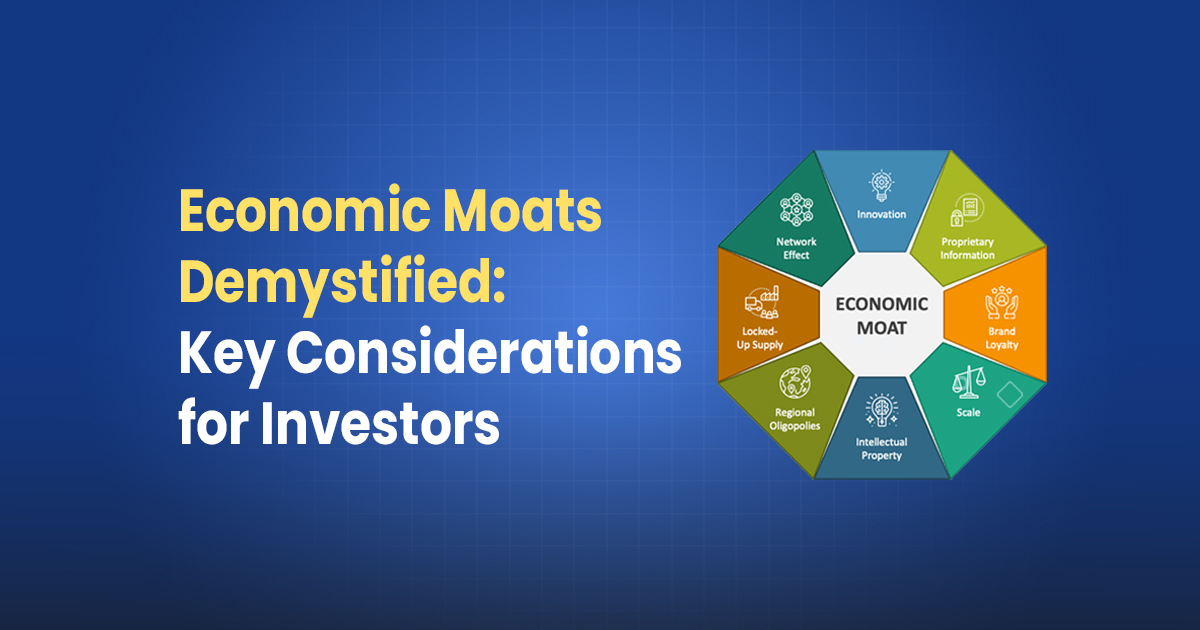
Some companies can maintain their market position for years because of advantages that are difficult for competitors to replicate. These advantages are often described as economic moats and can come from strong brands, cost structures, networks, intellectual property or high switching costs. Understanding these factors can help investors assess how a company’s competitive position may influence its business over time. This article explains what economic moats are, the different types of competitive advantages, and how they can influence companies in the Indian stock market.
What Is an Economic Moat?
An economic moat is a competitive advantage that can help a company protect its market position from competitors.
The concept is similar to a moat surrounding a fortress. Just as a physical moat can make a fortification harder to attack, a strong business advantage can make it harder for competitors to take away customers or market share.
A moat does not guarantee that a company will remain successful. Competitive advantages can weaken because of technological changes, new competitors, regulation or changes in consumer behaviour.
Why Economic Moats Matter
Companies operating in competitive industries may need to continuously invest in products, technology, distribution and marketing to maintain their position.
A business with a strong competitive advantage may have greater ability to retain customers and defend its stock market position.
Investors studying a company can therefore look beyond its recent financial performance and examine why customers choose its products or services in the first place.
Types of Economic Moats
Economic moats can develop in several ways. Some businesses may have one dominant advantage, while others may combine multiple sources of competitive strength.
Strong Brands
A recognised brand can influence customer preferences and purchasing decisions.
Companies with established brands may benefit from customer familiarity and trust. However, brand strength needs to be supported by consistent products, services and customer experience.
Cost Advantages
Some companies can produce or distribute goods at a lower cost because of their scale, supply chain structure, technology or operating model.
A cost advantage can allow a company to compete on price while maintaining its business economics.
Network Effects
A network effect occurs when a product or service becomes more useful as more people use it.
Digital platforms, payment networks and marketplaces can exhibit this characteristic. As participation increases, the network can become more valuable to users and potentially more difficult for new competitors to replicate.
Intellectual Property
Patents, proprietary technology and specialised processes can provide businesses with protection from direct competition for a period.
Intellectual property can be particularly relevant in sectors where research, development and specialised knowledge are important.
Economic Moats in the Indian Stock Market
Indian companies operate across sectors with different competitive structures. Banking, consumer goods, information technology, automobiles, pharmaceuticals and telecommunications stocks can each have different sources of competitive advantage.
For example, a consumer company may benefit from brand recognition and distribution, while a technology business may depend more heavily on specialised capabilities and customer relationships.
The relevant moat therefore needs to be considered in the context of the company’s industry.
How to Identify a Company’s Competitive Advantage
Investors can examine several aspects of a business when assessing its moat.
Useful questions include:
- Does the company have strong customer loyalty?
- Is its cost structure difficult for competitors to match?
- Does it benefit from a large distribution network?
- Are customers likely to face switching costs?
- Does the company have valuable intellectual property?
- Does scale create an advantage?
- Can new competitors enter the industry easily?
These questions can help investors understand the source of a company’s competitive position.
Moat vs Market Share
Market share and economic moat are related but not identical.
A company may have a large market share without having a durable competitive advantage. Competitors may be able to enter the market and gradually take customers away.
Conversely, a company with a smaller market share may still possess a specialised advantage that protects its position within a particular segment.
Investors should therefore examine why a company has its market position rather than focusing only on the size of that position.
Financial Indicators to Study
Financial statements can provide clues about the strength and durability of a company’s business model.
Investors may examine:
| Indicator | What It Can Indicate |
| Revenue growth | Changes in business scale |
| Operating margin | Efficiency of the operating model |
| Return on capital | How effectively capital is deployed |
| Cash flow | Ability to generate cash from operations |
| Debt levels | Financial structure |
| Customer retention | Strength of customer relationships |
These indicators should be assessed over multiple periods and compared with relevant industry conditions.
Conclusion
Economic moats help explain why some companies can maintain competitive positions despite operating in markets where competitors are constantly trying to gain market share. Brands, cost advantages, network effects, switching costs and intellectual property are some of the factors that can contribute to these advantages. For investors using platforms such as 5Paisa, studying a company’s competitive position alongside its financial performance and valuation can provide additional context when analysing stocks. A moat should be viewed as one part of a broader investment analysis rather than as a standalone indicator.