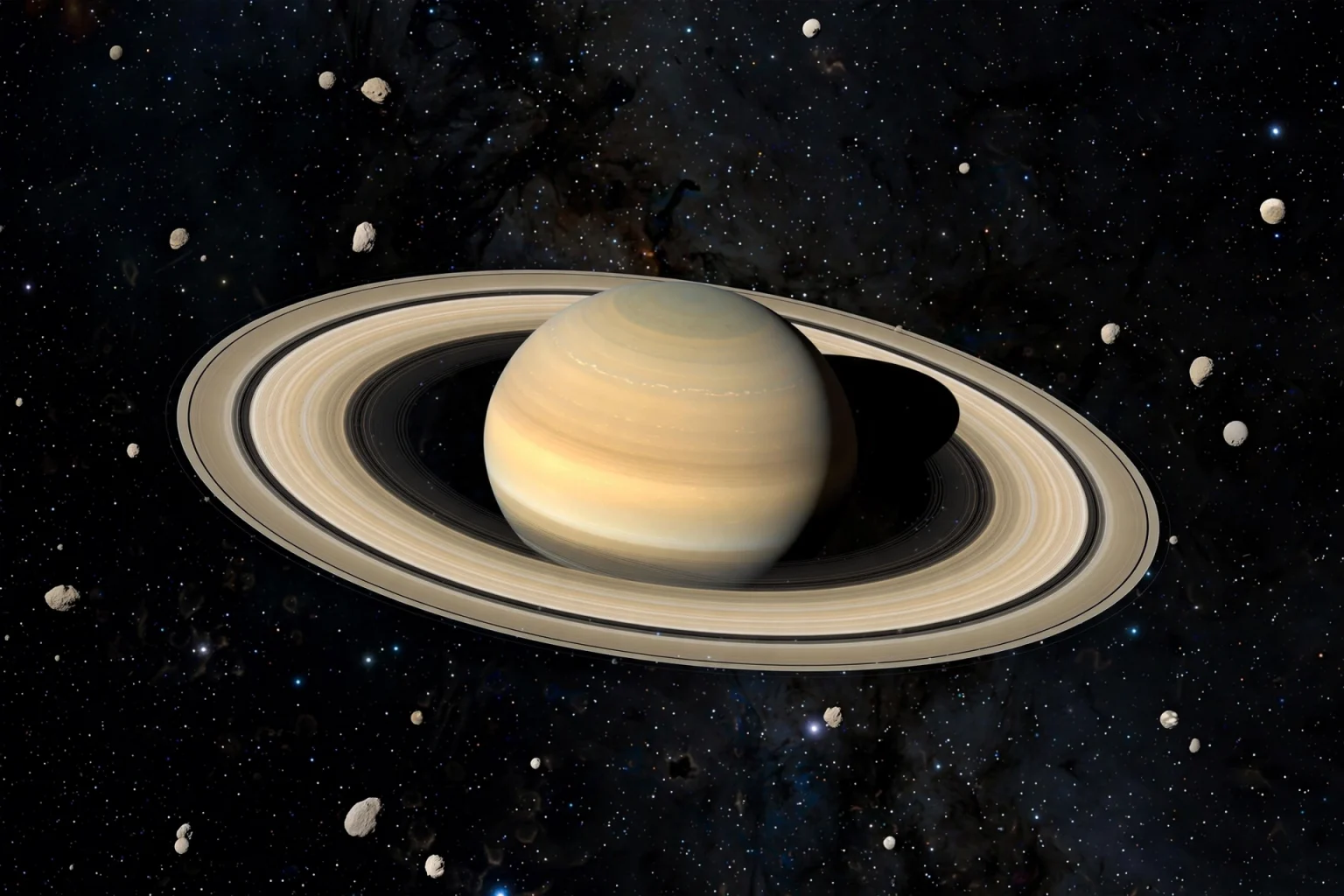

Saturn has pulled further ahead in one of astronomy’s quieter contests. Researchers have confirmed 128 previously unrecognised moons orbiting the ringed planet, a haul that lifts its official total to 274 and gives it, by a wide margin, the largest family of moons anywhere in the solar system. The new worlds are small, faint and irregular, yet each one is a clue to how the outer planets gathered material — and collided with their neighbours — billions of years ago.
The additions follow careful analysis of images gathered with the Canada-France-Hawaii Telescope on Mauna Kea, where a team linked to the University of British Columbia tracked faint moving points of light across several observing seasons. Once their orbits were calculated securely enough, the discoveries were recognised by the International Astronomical Union, the body that formally catalogues such objects.
A survey built on patience, not a single lucky night
Finding moons this dim is less like spotting something new in a single photograph and more like proving that the same speck has followed Saturn faithfully for years. The astronomers stacked dozens of exposures so that faint objects brightened while background stars smeared, then returned season after season to confirm each candidate still travelled with the planet. Only when an orbit could be predicted reliably did a candidate graduate from a smudge to a moon.
That method explains why so many moons arrived at once. The objects were not suddenly created; they were waiting in data that needed time, computing power and follow-up observations to interpret. Readers who enjoy slow, evidence-led science may also like our recent look at what a study found in everyday plastic tea bags, another story where careful measurement changed a familiar picture.
Why so many of the new moons look alike
Most of the newcomers belong to irregular families: distant, tilted and often backwards, or retrograde, orbits that suggest they were not born beside Saturn at all. Instead, they are probably fragments of larger bodies captured by Saturn’s gravity and later shattered by collisions. When several moons share a similar orbit and speed, astronomers read them as shards of one parent object, broken apart in an ancient impact.
Grouping the moons this way turns a headline number into a history book. Each family records a collision, and the spread of its fragments hints at when the break-up happened and how violent it was. The University of British Columbia team describes the work on its research pages at the University of British Columbia, where the emphasis is firmly on what these fragments reveal about the young solar system.
What 274 moons does — and does not — change
The new total does not alter Saturn’s familiar face through a backyard telescope, and none of the new moons will rival Titan or Enceladus for interest. Their value is statistical and forensic. A bigger census sharpens models of how giant planets capture debris, how rings and moons exchange material, and how often destructive collisions reshaped the outer solar system long after the planets themselves had formed.
It also raises a practical question: how many more are still hiding? Surveys keep pushing to fainter limits, and each improvement in sensitivity has historically revealed another layer of small bodies. Astronomers caution that counts will keep changing as instruments improve, so 274 should be read as the best current census rather than a final answer carved in stone.
A record that may not last forever
For now, though, the record is emphatic. Jupiter, Saturn’s nearest rival in this particular race, trails far behind, and no other planet comes close. Future telescopes may add still more tiny attendants to Saturn’s retinue, or refine some orbits, but they are unlikely to overturn the basic story: the ringed planet sits at the centre of the most crowded, collision-scarred moon system we know. For a planet already famous for its rings, it is a fitting second claim to fame — a vast, untidy family, still being counted, one faint speck at a time.