
Understanding how to convert mm to inches is important in many daily and professional tasks. Whether you are working on school projects, construction work, engineering designs, or online shopping, measurements often need to be converted between millimeters and inches. Different countries use different measurement systems, so knowing the correct conversion method helps avoid mistakes and confusion.
Millimeters belong to the metric system, while inches are part of the imperial system. The metric system is widely used across the world because of its simplicity and accuracy. However, inches are still commonly used in countries like the United States for manufacturing, screen sizes, furniture, and tools. Learning the conversion between these two units makes calculations faster and more reliable.
MM Mean
MM stands for millimeters. A millimeter is a small unit of length in the metric system. It is commonly used to measure tiny objects, thickness, and precise dimensions. There are 1000 millimeters in one meter.
Millimeters are often used in industries such as engineering, automotive manufacturing, medical equipment, and architecture because they provide accurate measurements. Small objects like screws, pipes, wires, and machine parts are usually measured in millimeters.
Inches Mean
An inch is a unit of length used mainly in the imperial measurement system. It is widely used in the United States, Canada, and the United Kingdom for certain applications.
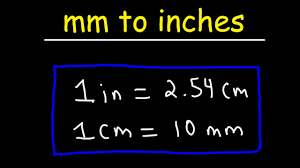
Inches are commonly used to measure television screens, laptop displays, furniture sizes, and height. One inch equals 2.54 centimeters or 25.4 millimeters.
How to Convert MM to Inches
The conversion process from mm to inches is simple. You only need to divide the number of millimeters by 25.4.
1 inch=25.4 mm1\ \text{inch}=25.4\ \text{mm}1 inch=25.4 mm
Conversion Formula
To convert millimeters into inches:
Inches=Millimeters25.4\text{Inches}=\frac{\text{Millimeters}}{25.4}Inches=25.4Millimeters
For example, if you want to convert 50 mm into inches:
50 ÷ 25.4 = 1.97 inches
This means 50 millimeters is equal to approximately 1.97 inches.
Common MM to Inches Conversion Table
| Millimeters | Inches |
| 1 mm | 0.039 inches |
| 5 mm | 0.197 inches |
| 10 mm | 0.394 inches |
| 20 mm | 0.787 inches |
| 25 mm | 0.984 inches |
This table can help you quickly find approximate conversions without using a calculator.
Why MM to Inches Conversion Is Important
Measurement conversion is useful in many industries and everyday activities. People often purchase products online from international stores where measurements may appear in a different system. Accurate conversion helps ensure the correct product size.
Construction workers, mechanics, and engineers regularly convert measurements to maintain precision in projects. Even students and teachers use these conversions during mathematics and science lessons.
Another important reason is compatibility. Machine parts manufactured in one country may use metric measurements, while another country may use imperial measurements. Correct conversion prevents fitting errors and reduces waste.
Tools Used for MM to Inches Conversion
Online Conversion Calculators
Many websites provide instant measurement conversion tools. You simply enter the millimeter value, and the calculator automatically converts it into inches.
Mobile Applications
Smartphone apps can quickly convert measurements anytime and anywhere. These apps are useful for students, travelers, and professionals.
Manual Calculations
Some people still prefer using the formula manually because it improves understanding and accuracy. Manual conversion is especially helpful during exams or technical work where calculators may not be available.
Tips for Accurate Measurement Conversion
Use Correct Decimal Points
Small errors in decimal placement can create large measurement mistakes. Always double check your calculations.
Round Carefully
In some industries, exact measurements are important. Avoid rounding too early during calculations.
Use Reliable Tools
Choose trusted calculators or conversion charts to avoid inaccurate results. High quality measuring tools also improve precision.
Differences Between Metric and Imperial Systems
The metric system is based on units of ten, making calculations easier and more organized. Most countries use the metric system because it is internationally accepted.
The imperial system uses units like inches, feet, and yards. Although it is older, it is still commonly used in certain countries and industries.
Understanding both systems is beneficial because global trade and communication often require converting between them.
Conclusion
Learning how to convert mm to inches is a valuable skill for students, professionals, and everyday users. Millimeters and inches are widely used measurement units in different parts of the world, and understanding their relationship improves accuracy in work and daily tasks. By using the simple conversion formula and reliable tools, anyone can quickly convert measurements without difficulty. Whether you are shopping online, working on technical projects, or studying mathematics, accurate conversion helps save time and prevents mistakes.
FAQ’s
What is the formula for converting mm to inches?
The formula is simple. Divide the millimeter value by 25.4 to get the measurement in inches.
How many millimeters are in one inch?
There are exactly 25.4 millimeters in one inch.
Why do people convert mm to inches?
People convert measurements because different countries and industries use different measurement systems.
Is mm smaller than inches?
Yes, a millimeter is much smaller than an inch. One inch contains 25.4 millimeters.
Can I convert mm to inches without a calculator?
Yes, you can use a conversion chart or manually divide the millimeter value by 25.4.